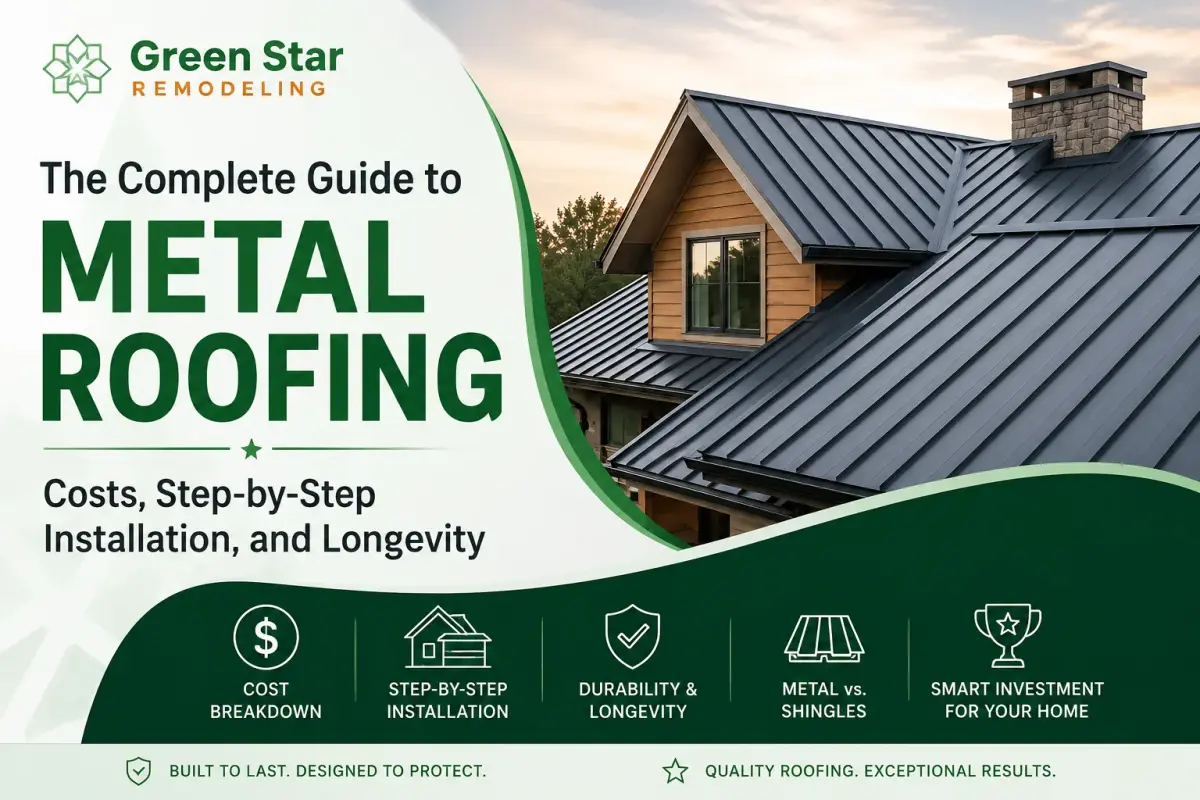
Metal roofing is a roof covering made from steel, aluminum, tin, zinc, or copper panels instead of asphalt shingles. It costs more upfront than shingles but lasts two to three times as long. This guide walks through how metal roofing compares to shingles, what it costs by material type, how installers actually put it on a roof, and how long you can expect it to last.
Metal Roofing vs. Traditional Shingles: A Comparative Analysis
Metal roofing and asphalt shingles solve the same problem in different ways. Metal panels lock or fasten together in long sheets, while shingles overlap in small individual pieces. That single design difference drives most of the cost, lifespan, and maintenance gaps between the two materials.
Are Metal Roofs Better Than Shingles?
Metal roofs outperform shingles in lifespan, fire resistance, and energy efficiency. A metal roof lasts 40 to 70 years, while asphalt shingles last 20 to 30 years, according to 2026 cost data from This Old House. Metal also reflects heat instead of absorbing it, which can lower cooling costs in warm climates like Los Angeles.
Shingles still win on upfront price and repair simplicity. A cracked shingle is a fast, cheap fix. A damaged metal panel sometimes needs a full panel replacement, which costs more per repair. If you are still deciding between materials, our guide to asphalt shingle roofing breaks down where shingles make the most sense.
Is a Metal Roof Cheaper Than Shingles Long-Term?
Yes, in most cases. A metal roof often avoids a second full roof replacement that a shingle roof would need within the same 40-to-50-year window. Asphalt shingle roofs typically get replaced once or twice in that time, and each replacement adds a new full labor and material cost.
Metal roofing also holds resale value well, since buyers factor in the years remaining before another roof replacement is due, a number that stays high for decades on a metal roof and much lower on an aging shingle roof.
| Factor | Metal Roofing | Asphalt Shingles |
|---|---|---|
| Typical lifespan | 40 to 70 years | 20 to 30 years |
| Upfront cost | Higher | Lower |
| Replacements over 50 years | Usually 0 to 1 | Usually 1 to 2 |
| Fire resistance | Non-combustible | Combustible |
| Weight | Lightweight, low structural load | Moderate weight |
| Environmental impact | Often recyclable, reflects heat | Petroleum-based, typically landfilled |
Tin roofs are better than shingles for the same reasons steel and aluminum are. Tin, now mostly meaning tin-coated steel, shares the same lifespan and fire-resistance advantages as other metal roofing types, just at a lower material cost.
Understanding Metal Roofing Costs and Budget Factors
In Los Angeles, homeowners can expect to pay about $7 to $18 per square foot installed for a metal roof. The final cost depends on the roofing style, panel thickness, coating, roof design, and labor requirements. Corrugated steel offers a more affordable option, while standing seam aluminum provides a premium appearance, durability, and a higher upfront investment.
Average Upfront Cost for a Residential Roof
On a typical 2,000-square-foot Los Angeles home, that per-square-foot range translates to roughly $14,000 to $30,000 installed, depending on panel system and roof complexity.
Material Breakdown: Steel vs. Tin Roof Cost
Steel is the most common metal roofing choice in Los Angeles because it balances strength, price, and lifespan. Within steel alone, the finish and gauge shift the price:
| System (Los Angeles, Installed) | Cost per Sq Ft | Best For |
|---|---|---|
| Corrugated / R-panel steel (exposed fastener) | $7 to $10 | Budget-conscious buyers, sheds, garages |
| Standing seam steel | $9 to $15 | Most residential roofs |
| Standing seam aluminum | $12 to $18 | Coastal areas, corrosion resistance |
Within standing seam steel, panels with a PVDF (Kynar 500) finish hold their color longer under direct Los Angeles sun than the more basic SMP finish, which can fade noticeably within 10 to 15 years.
Tin roofing, now almost always tin-coated steel rather than pure tin, is not commonly quoted as its own category in the LA market. Contractors typically price it within the corrugated or R-panel steel range above. It is softer than standard steel, so it dents more easily under hail or foot traffic.
Hidden Cost Factors: Panels, Underlayment, and Professional Labor
Roof complexity raises the price. Valleys, skylights, dormers, and steep pitches all add flashing work and installation time.
Two Los Angeles-specific factors are easy to miss when budgeting: LADBS permit fees, and additional Chapter 7A fire-rated assembly requirements for homes in a Very High Fire Hazard Severity Zone. Ask your contractor to include both in your quote up front.
If you’re weighing a metal roof against other roofing materials for your home, our common roof types guide compares gable, hip, and flat roof shapes, since your roof’s shape affects which metal panel style fits best.
How to Install Metal Roofing: The Definitive Step-by-Step Guide
Metal roof installation requires precise structural planning, proper underlayment selection, and careful alignment of panel overlaps to prevent moisture from getting in. The process differs based on panel style, roof pitch, and whether you’re installing over bare decking or an existing shingle roof.
Essential Materials: Understanding Panels, Widths, and Profiles
Metal roofing panels typically come 12 to 24 inches wide, though width varies by manufacturer and profile. Standing seam metal roof panels use raised vertical seams that lock together mechanically, hiding the fasteners from view. Exposed-fastener panels, sometimes called corrugated or R-panel systems, use visible screws driven through the panel face.
Standing seam systems cost more but resist leaks better, since there are no exposed screw holes for water to work through over time. Exposed-fastener panels cost less and install faster, making them common on garages, sheds, and budget-focused projects.
Can You Install a Metal Roof Over Existing Shingles?
Yes, in many cases, though local building codes set limits. Most jurisdictions following the International Building Code allow a maximum of two roofing layers on a structure. If your roof already has two layers of shingles, code requires a full tear-off before installing metal panels.
Installers commonly attach 1x4 wood furring strips over the existing shingles, then fasten the metal panels to those strips. This creates a flat, level surface and an air gap that lets moisture escape instead of getting trapped between the old and new layers. Always confirm your specific local code before choosing this method, since requirements vary by city and county. Our overview of the roof replacement process explains when a tear-off makes more sense than a layover.
Step 1: Measuring, Sub-Roof Preparation, and Waterproofing
Measure the full roof area and each slope separately, since panels install by the linear run of each roof plane. Install synthetic underlayment across the entire deck before placing any panels, since this layer acts as the roof’s backup waterproofing if a panel seam ever fails.
Step 2: How to Cut and Overlap Metal Roofing Panels Safely
Cut metal panels with a fiber cement shear, nibbler, or metal-cutting circular saw blade rather than an abrasive cutoff wheel, since abrasive blades leave hot metal shavings that can rust into the panel’s finish. Side laps on exposed-fastener panels typically overlap by one full rib. End laps, used when a single panel doesn’t span the full roof length, need 6 to 12 inches of overlap depending on roof pitch, sealed with butyl tape and placed directly over solid structural support.
Step 3: Where to Place Fasteners and Screws on a Metal Roof
Drive fasteners into the flat part of the panel between ribs, not through the raised rib itself, since the rib has no solid backing underneath to compress against. Standard fastener spacing runs 12 to 24 inches along the panel field, with tighter spacing required at eaves and rakes, where wind uplift is strongest. Standing seam panels use hidden clips instead of face fasteners, so screws never show on the finished roof.
Step 4: Installing the Ridge Cap and Edges
Install the ridge cap last, once all field panels are in place and trimmed to the roof’s peak. The ridge cap covers the gap where two roof slopes meet, sealing out wind-driven rain and snow. Eave and rake trim get installed before the field panels in most systems, giving the panels a finished edge to butt against.
How to Install Metal Roofing on a Shed or Small Structure
A shed roof installation follows the same core steps at a smaller scale. Measure the single or double slope, install underlayment, then run panels from one edge to the other, overlapping each panel by one rib as you go. Sheds rarely need ridge caps unless the roof has two slopes meeting at a peak, and most shed installations use exposed-fastener panels for simplicity and lower cost.
A licensed roofing contractor who handles measuring, cutting, fastening, and trim work as one connected process typically delivers a tighter, more leak-resistant result than a piecemeal DIY approach on a full-size home, since seam sealing and fastener placement both depend on getting the step before them right.
Longevity, Maintenance, and Common Myths
A metal roof’s lifespan depends on the metal type, coating quality, and how well it was installed. Steel roofs last up to 60 years, tin-coated steel up to 70 years, and copper can exceed 100 years with basic upkeep.
How Long Does a Metal Roof Last? (Steel vs. Tin Lifespans)
Steel roofing lasts up to 60 years when properly coated and maintained. Tin-coated steel can last even longer, up to 70 years, though it dents more easily than standard steel gauges. Zinc and copper outlast both, often reaching 100 years or more, thanks to a natural patina layer that protects the metal as it ages.
Myth vs. Fact: Do Metal Roofs Attract Lightning or Cause Excessive Noise?
Metal roofs do not attract lightning any more than any other roofing material. Lightning strikes the tallest, most exposed point with the clearest path to the ground, regardless of what that point is made of. The Metal Roofing Alliance, the National Fire Protection Association, and Underwriters Laboratories all confirm metal roofing carries no added lightning risk. If lightning does strike a metal roof, the metal’s conductivity actually helps disperse the electrical charge rather than concentrating it.
Metal roofs are not inherently noisier than shingle roofs. Older, thin metal sheeting installed directly over open rafters could sound loud during rain. Modern installations use solid roof decking, underlayment, and insulation beneath the panels, which dampens sound to a level similar to asphalt shingles.
Long-Term Care: How to Clean, Paint, and Repaint Metal Panels
Rinse a metal roof with a garden hose once or twice a year to remove dirt, pollen, and debris buildup. Avoid pressure washers, since high-pressure water can force its way under seams and panel laps. Repainting becomes necessary when the factory finish starts chalking or fading, typically after 20 to 30 years, depending on climate and coating quality. Use a paint formulated specifically for metal roofing, since standard exterior paint won’t bond correctly to a painted metal surface.
Integrating Modern Upgrades: Can You Put Solar Panels on a Metal Roof?
Yes, and standing seam metal roofs are one of the easiest roof types to add solar panels to. Installers can clamp solar mounts directly onto the raised seams, avoiding any new roof penetrations that could create a leak point. This is a real advantage over shingle roofs, where solar mounts typically require drilling and sealing new holes through the roofing material itself.
You can walk on most metal roofs, though it should be done carefully. Step near the panel ribs or directly over the roof deck’s structural framing, not in the flat center of a panel span, to avoid denting the metal.
Frequently Asked Questions
How much does a metal roof cost?
In Los Angeles, installed pricing runs roughly $7 to $18 per square foot depending on the panel system and metal type, which puts a typical residential roof in the $14,000 to $30,000 range.
How long does a metal roof last?
A steel roof lasts up to 60 years, tin-coated steel up to 70 years, and copper or zinc can exceed 100 years. All three outlast asphalt shingles, which typically last 20 to 30 years.
Can you install a metal roof over shingles?
Yes, if your roof has one existing layer of shingles and your local building code allows it. Most codes cap roofs at two layers total, so a roof with two existing shingle layers needs a full tear-off first.
Do metal roofs attract lightning?
No. Metal roofs are no more likely to be struck by lightning than any other roofing material, according to the Metal Roofing Alliance, NFPA, and Underwriters Laboratories. Height and location determine lightning strikes, not roofing material.
Planning a new roof in greater Los Angeles? Green Star Remodeling handles metal roof measurement, installation, and trim work as one process. Contact our team for a free consultation.